
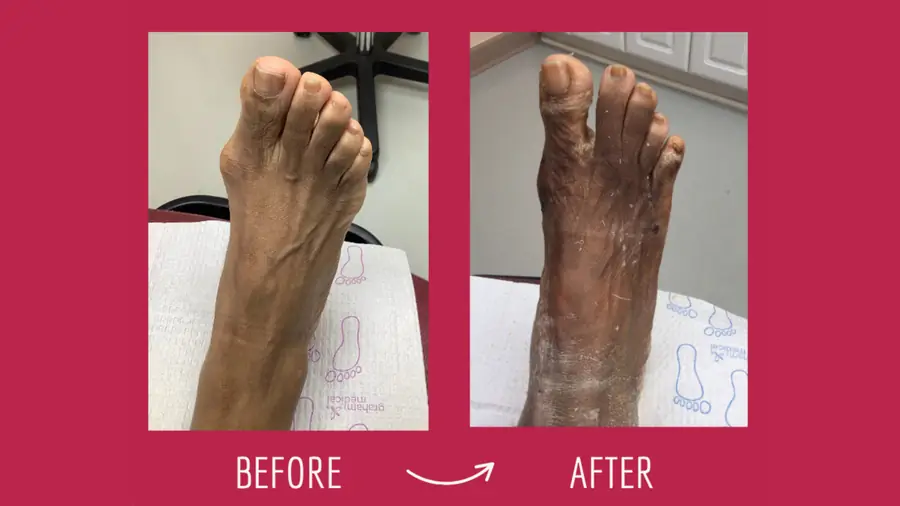
A bunion starts small. A little bump at the base of the big toe, a shoe that pinches where it never used to. Then one day the shoes you love sit in the closet, because ten minutes in them is ten minutes too many. If that sounds familiar, you are in the right place.
Dr. Vivian Iwu is a board certified podiatrist and the founder of Choice Podiatry Center in Marietta. She treats bunions every week, and the first thing she tells patients is this: not every bunion needs surgery. When surgery is the right answer, the way it is done today looks very different from the operation your mother or grandmother may remember.
What Is a Bunion, Really?
A bunion is a bony bump that forms at the base of the big toe. It happens when the bones at the front of the foot shift out of alignment, which pushes the joint outward and pulls the big toe toward the smaller toes.
Common symptoms include swelling and redness around the joint, a bump that grows more noticeable over time, aching that lingers after you sit down, and a big toe that leans toward its neighbors. Many people also find that certain shoes simply stop fitting.
Left alone, a bunion can make everyday movement harder. Walking and standing turn into something you plan around rather than something you do without thinking.
It is worth saying clearly: a bunion is a structural change in the foot, not just a callus or a bump on the skin. That is why creams and home remedies do not make it go away. The bone itself has shifted, and only measures that address that shift, or work around it, will help.
What Causes Bunions to Get Worse?
Genetics is the main driver. Most people who develop bunions inherited the foot structure that makes them likely. You do not cause a bunion by wearing the wrong shoes, but tight or pointed shoes can speed up how fast it progresses.
A few other factors play a part. Arthritis in the joint, the particular way your foot moves when you walk, and long hours on your feet can all push a bunion along faster than it would otherwise go.
Conservative Treatment: When Surgery Is Not Needed Yet
For many people, the goal is to slow the bunion down and stay comfortable without an operation. Dr. Iwu usually starts here.
Footwear and daily habits
Roomier shoes with a deep toe box take pressure off the joint. For everyday wear, keeping heels under two inches makes a real difference. It will not straighten the toe, but it can calm the pain.
Custom orthotics
Choice Podiatry Center fits custom orthotics in the office through a simple four step process: an assessment of your foot and gait, impressions of your feet, a custom design, and a fitting check to confirm everything sits right. Good orthotics redistribute pressure so the bunion joint is not carrying more than its share.
The value of a custom orthotic is that it is made for your foot, not an average foot. Over the counter inserts can help a little, but they cannot account for the specific way your bunion has changed how you bear weight. A device shaped to your foot supports it where it needs support and offloads the joint that hurts.
Padding, taping, and pain relief
Bunion pads, splints, and medication to reduce inflammation can ease everyday discomfort. These slow the progression and keep you moving. What they do not do is reverse the bunion, and it helps to be honest about that from the start.
When It Is Time to Consider Bunion Surgery
Surgery comes into the conversation when the bunion starts affecting your quality of life, or when the joint itself is at risk. Watch for these signs:
- Pain that no longer responds to shoe changes, orthotics, or padding
- Trouble getting through normal daily activities
- A deformity you can see getting worse
- Stiffness or arthritis settling into the joint
Minimally Invasive Bunion Surgery at Choice Podiatry Center
When surgery is the right call, Dr. Iwu offers a minimally invasive approach. Instead of one large incision, the correction is made through very small openings. For patients, that changes the experience in four ways:
- Less pain during and after the procedure
- Minimal scarring, which matters if you wear sandals or open toe shoes
- Faster recovery, so you return to your routine sooner than you would after a traditional bunionectomy
- Lower risk of complications and less swelling
The procedure is performed in the office at Choice Podiatry Center. No hospital admission, no long waits, and scheduling that works around your life.
The minimal scarring point is not about vanity. For someone who spends summers in sandals, or who simply does not want a visible reminder on their foot, a smaller incision genuinely matters. The faster recovery matters even more for people who cannot take two or three months away from work or family responsibilities.
What Recovery Actually Looks Like
Every foot heals on its own timeline, and Dr. Iwu will give you a plan built around yours. As a general picture, minimally invasive recovery tends to move like this:
- Week 1: rest and elevation, with a protective surgical shoe
- Weeks 2 to 4: a gradual return to normal footwear
- Weeks 4 to 6: most patients are walking comfortably
For comparison, traditional bunion surgery often takes closer to eight to twelve weeks to reach the same milestones. That gap is the main reason patients ask about the minimally invasive option.
Try not to rush your own timeline based on someone else’s. Age, general health, the severity of the bunion, and how closely you follow the aftercare plan all affect how quickly you heal. Dr. Iwu would rather you recover well than recover fast, and she will tell you when it is safe to move to the next stage.
Why Patients Choose Dr. Vivian Iwu
Dr. Iwu is board certified in podiatric medicine and surgery, and she founded Choice Podiatry Center to give Cobb County a place for personal, unhurried foot care. She builds each treatment plan around the individual foot in front of her, because no two bunions behave exactly the same way. The office at 540 Powder Spring St, Suite B6 is clean, welcoming, and easy to reach.
Ready to Get Started?
If your bunion has started dictating which shoes you can wear, a consultation is the simplest next step. Dr. Iwu will look at the joint, talk through your options, and help you decide whether conservative care is enough or whether surgery makes sense.
Book online or call (770) 702-8723. Choice Podiatry Center accepts most major insurance plans, including United, Medicare, Cigna, BCBS, Anthem, Aetna, and CareSource.
Frequently Asked Questions
Does every bunion need surgery?
No. Many bunions are managed for years with roomier footwear, custom orthotics, padding, and medication to reduce inflammation. Dr. Iwu recommends surgery only when the bunion affects your quality of life or threatens the joint.
How is minimally invasive bunion surgery different from traditional surgery?
It corrects the bunion through very small incisions instead of one large one. Patients generally have less pain, minimal scarring, less swelling, and a faster return to normal activities.
How long is recovery after minimally invasive bunion surgery?
It varies by patient. Many people wear a protective surgical shoe in the first week, move back into normal shoes over weeks two to four, and are walking comfortably by weeks four to six.
Is bunion surgery done in a hospital?
At Choice Podiatry Center the procedure is performed in the office, with no hospital admission and flexible scheduling.
Does insurance cover bunion treatment?
Choice Podiatry Center accepts most major insurance plans, including United, Medicare, Cigna, BCBS, Anthem, Aetna, and CareSource. Coverage for a specific procedure depends on your plan.