
Pickup basketball, trail runs, tennis matches, long walks, and weekend workouts can make summer more active. They can also expose the feet and ankles to sudden direction changes, uneven ground, repetitive impact, and activity levels the body may not be prepared for.
A mild ache after exercise may settle with rest. A true injury can worsen when it is ignored or repeatedly tested. Knowing the difference matters—especially when an ankle sprain in Marietta is followed by swelling, instability, or difficulty bearing weight.
This guide explains common summer foot and ankle injuries, what you can do immediately, and when it is safer to stop self-treatment and schedule an evaluation.

Why Summer Means More Foot and Ankle Injuries
Summer often creates a rapid change in activity. Someone who spent spring mostly indoors may suddenly begin running, joining recreational sports, hiking, or walking for hours while traveling.
Heat, fatigue, unfamiliar surfaces, worn shoes, and inadequate recovery can also affect movement. The problem is not always one dramatic accident; it may develop because activity increases faster than the body can adapt.
Common risks include sudden mileage increases, court sports, uneven trails, poorly fitted shoes, returning after a break, and continuing despite early pain. Responding early to pain, swelling, or instability may prevent a minor problem from becoming a longer interruption.
Ankle Sprains: Grades, First Response, and Why “Walking It Off” Can Backfire
An ankle sprain occurs when one or more ligaments are stretched or torn, often after the foot rolls inward. Symptoms may include pain, swelling, bruising, stiffness, and a feeling that the ankle is unstable.
Sprains are commonly described by severity:
Grade 1: Mild
The ligament is stretched with small microscopic injury. Swelling and tenderness are usually mild, and walking may still be possible.
Grade 2: Moderate
There is a partial ligament tear. Swelling, bruising, pain with weight-bearing, and reduced motion are more noticeable.
Grade 3: Severe
The ligament is completely torn. The ankle may be very swollen, unstable, and difficult or impossible to bear weight on.
You cannot reliably grade every sprain by appearance alone. Fractures, tendon injuries, and high ankle sprains may look similar.
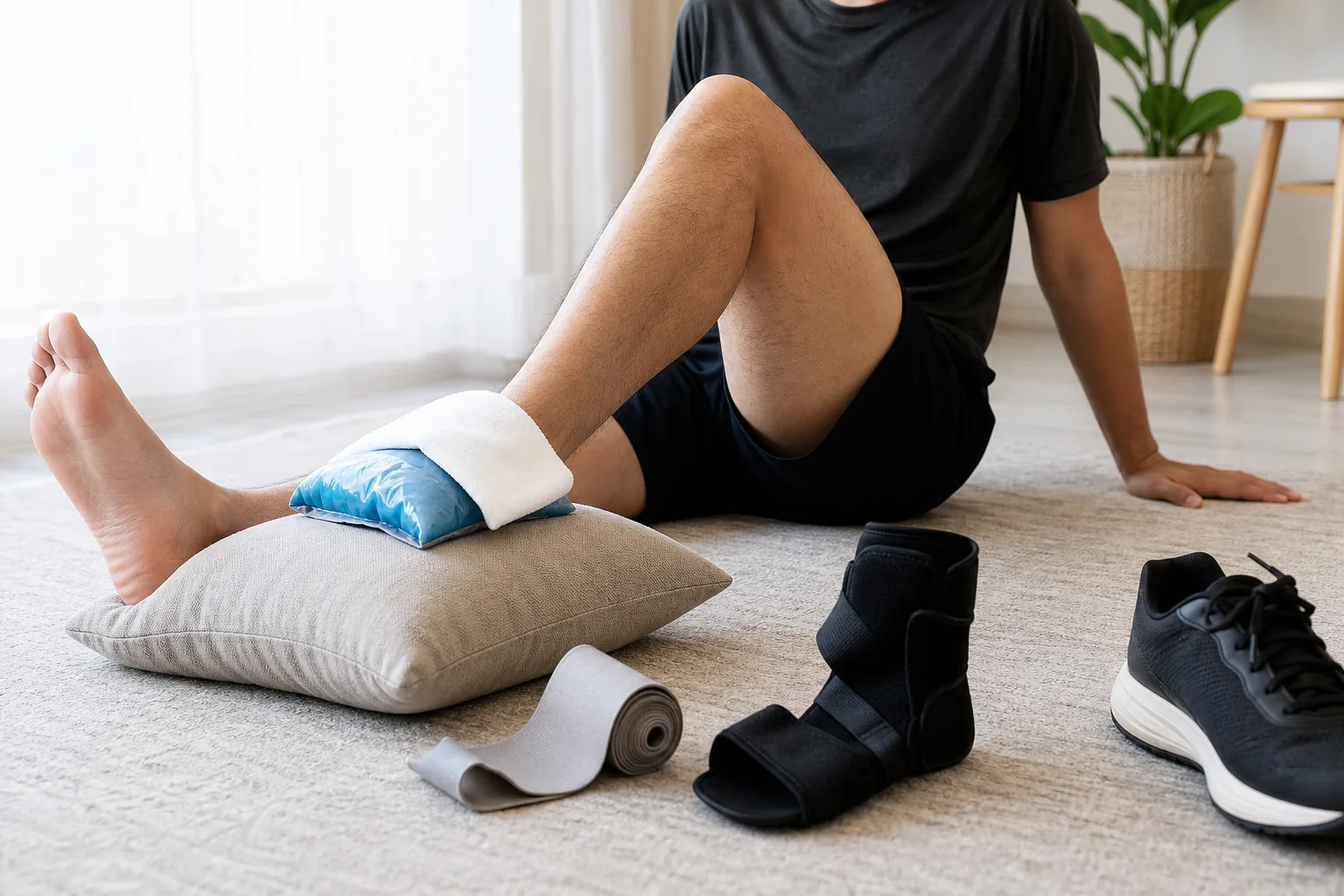
The first response: protect, rest, ice, compression, and elevation
The familiar R.I.C.E. approach includes rest, ice, compression, and elevation. It is also important to protect the ankle from further injury.
- Protect: Stop the activity. Use a brace, supportive shoe, or crutches when needed.
- Rest: Avoid movements that reproduce sharp pain.
- Ice: Apply a wrapped cold pack for up to 15–20 minutes at a time.
- Compression: Use an elastic wrap without making it so tight that the toes become numb, cold, pale, or discolored.
- Elevation: Raise the ankle above heart level when practical to help manage swelling.
Do not apply ice directly to the skin. People with poor circulation or reduced sensation should ask a clinician before cold therapy.
Why “walking it off” can make things worse
Continuing to play may increase swelling or worsen a ligament injury. Limping also changes how force moves through the rest of the body.
Being able to walk does not rule out a significant injury. Stop and seek assessment for severe pain, deformity, a crack at the time of injury, inability to take several steps, or major swelling and bruising. Our ankle sprain treatment in Marietta page has more on how we evaluate and treat these injuries.
Achilles Pain and Tendinitis: Warning Signs Not to Ignore
The Achilles tendon connects the calf muscles to the heel bone. It works whenever you walk, run, jump, or rise onto your toes.
Achilles pain often develops after increasing running mileage, adding hills or speed work, returning to a sport too quickly, or training in shoes that no longer provide adequate support.
Common warning signs include:
- Pain or stiffness at the back of the heel or lower calf
- Morning stiffness that eases after moving
- Tenderness when the tendon is gently pressed
- Pain that worsens during or after running and jumping
- Thickening or swelling around the tendon
- Reduced push-off strength
Do not stretch aggressively into sharp Achilles pain. Reduce running, jumping, and hill work, and choose supportive footwear. Appropriate Achilles pain treatment depends on the exact location and diagnosis.
A sudden pop, immediate weakness, or inability to push off or stand on the toes may indicate a rupture and needs prompt attention.

Forefoot Overload From Running
The forefoot absorbs substantial force during running, especially during speed work, hills, jumping, or a sudden mileage increase. Pain beneath the ball of the foot may come from overloaded joints, irritated soft tissue, nerve compression, or a bone stress injury.
Early forefoot overload may feel like:
- Burning or aching under the ball of the foot
- Tenderness beneath one or more metatarsal heads
- A feeling of walking on a pebble
- Pain that increases in thin or tight shoes
- Symptoms that worsen with distance
Reduce the triggering activity and inspect your shoes for compressed cushioning or a narrow toe box. Persistent pain should be evaluated because different causes require different treatment.

Stress Fractures: The Pain Pattern That Means Stop
A stress fracture is a small crack in a bone caused by repeated loading. It may develop when training volume increases faster than the bone can adapt.
Unlike general soreness, stress-fracture pain often becomes localized to one specific spot.
Warning signs include:
- Pain that starts during activity and improves with rest
- Pain that returns earlier during each workout
- One sharply tender point over a bone
- Swelling over the top or outside of the foot
- Pain with hopping or normal walking
- Pain that eventually continues even at rest
This is the pattern that means stop. Do not run through focal bone pain, because continued impact can worsen the injury.
Early X-rays may not show every stress injury. Additional imaging may be recommended based on the examination and suspected location.
DIY or Doctor? A Simple Decision Guide
Home care may be reasonable when:
- Pain is mild
- There is little or no swelling
- You can walk normally without limping
- There was no pop, crack, or visible deformity
- Symptoms improve when the activity stops
- The condition is clearly improving over the next few days
Use supportive footwear, reduce impact, protect the painful area, and return to activity gradually.
Schedule a podiatry evaluation when:
- Pain continues or returns every time you exercise
- You are limping or changing how you move
- Swelling or bruising is moderate to severe
- One specific bone is sharply tender
- The ankle repeatedly gives way
- Achilles pain is affecting push-off strength
- Symptoms are not steadily improving
- You need a safe return-to-sport plan
Seek urgent care when:
- The foot or ankle looks deformed
- You cannot bear weight after an injury
- There is an open wound or exposed bone
- The foot becomes cold, pale, blue, or numb
- You felt a sudden pop and lost strength
- Redness, warmth, swelling, or fever suggests infection
This decision guide is educational and cannot replace an examination.

How Dr. Iwu Evaluates and Rehabs Sports Injuries
At Choice Podiatry Center, Dr. Vivian Iwu begins by reviewing how the injury happened, where it hurts, how symptoms change with activity, and any recent training or footwear changes.
A sports-injury evaluation may include:
- Checking the exact location of tenderness
- Evaluating swelling, bruising, strength, and range of motion
- Testing ligament and tendon stability
- Assessing foot structure, balance, and walking mechanics
- Reviewing athletic shoes and wear patterns
- Ordering imaging when a fracture, rupture, or other injury is suspected
When appropriate, treatment begins conservatively. The plan may include bracing or immobilization, activity modification, footwear changes, orthotic support, rehabilitation, physical therapy, or a progressive return-to-sport program.
Rehabilitation may address ankle mobility, calf strength, balance, landing control, and contributing movement patterns.
Learn more about sports medicine services, explore our broader podiatry services, and meet Dr. Vivian Iwu.
Get the Injury Checked Before It Changes Your Summer
A sore foot or ankle does not always require an appointment. However, persistent pain, focal bone tenderness, weakness, instability, or difficulty bearing weight should not be treated as normal post-workout soreness.
Early evaluation can clarify whether you are dealing with a mild sprain, tendon overload, a stress injury, or another condition—and help you return to activity with a safer plan.
For a sports-injury evaluation with Dr. Vivian Iwu, call Choice Podiatry Center in Marietta at (770) 702-8723.
Medical note: This article provides general educational information and is not a substitute for an examination, diagnosis, emergency care, or individualized treatment plan.
Frequently Asked Questions
How do I know whether an ankle injury is a sprain or a fracture?
Both can cause pain, swelling, bruising, and difficulty walking. A visible deformity, inability to bear weight, severe focal bone tenderness, or a crack at the time of injury increases concern for a fracture. An examination and imaging may be needed to tell the difference.
Should I walk on a sprained ankle?
Walking may be acceptable with a very mild sprain if you can do so normally and without increasing pain. Do not “walk it off” when you are limping, swelling is increasing, the ankle feels unstable, or weight-bearing is significantly painful.
How long should I ice an ankle sprain?
A wrapped cold pack may be applied for up to 15–20 minutes at a time during the early stage of an injury. Never place ice directly on the skin, and use extra caution if you have reduced sensation or circulation problems.
What does Achilles tendinitis feel like?
Achilles tendinitis commonly causes pain, stiffness, or tenderness at the back of the heel or lower calf. Symptoms may be worse in the morning or during and after running, jumping, hill work, and other push-off activities.
Can I run with pain in the ball of my foot?
Running through persistent or increasingly localized forefoot pain is not recommended. Reduce impact and arrange an evaluation when pain changes your stride, returns during every run, causes swelling, or is sharply focused over one bone.
What are the warning signs of a stress fracture?
Stress-fracture pain often becomes localized to one point, worsens with impact, returns earlier in each workout, and may eventually occur during normal walking or at rest. Swelling and focal bone tenderness are additional warning signs.
When should I see a sports podiatrist?
See a sports podiatrist when foot or ankle pain persists, causes limping, involves significant swelling or bruising, limits athletic performance, repeatedly returns, or makes it difficult to return to activity safely.