
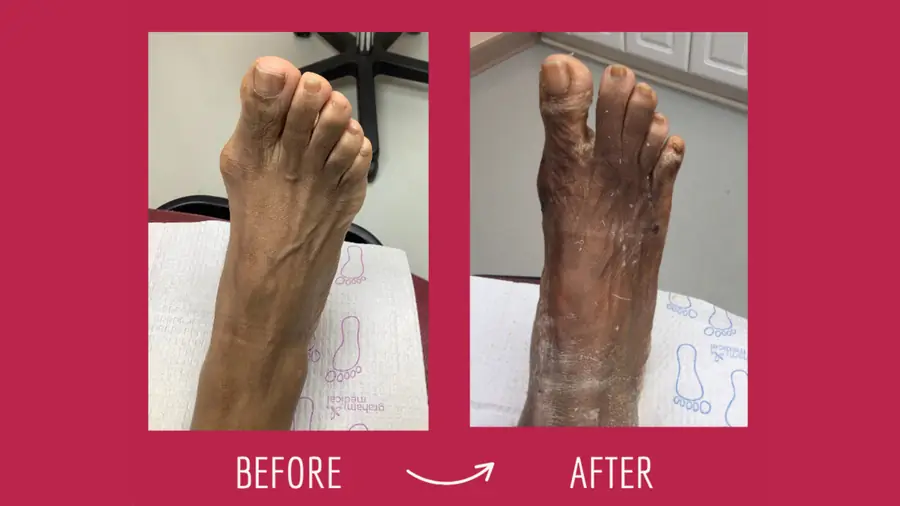
If you are looking for bunion treatment in Marietta, GA, you already know the feeling. That bony bump at the base of the big toe that turns a long walk into something you brace for. Shoes that used to be your favorites now sit at the back of the closet. Some days the discomfort fades into the background. Other days it follows you into every step.
At Choice Podiatry Center, Dr. Vivian Iwu provides bunion treatment in Marietta, GA for patients across Cobb County. She is board certified in podiatric medicine and surgery, and she does something a lot of local practices still don’t offer: minimally invasive bunion correction.
Here is what most people miss though. Not every bunion needs surgery. And when it does, the procedure today looks very different than it did even ten years ago.
What a bunion actually is
A bunion is a bony bump that forms at the base of the big toe. It happens because the bones in the front of your foot shift out of their normal alignment. Over time the big toe starts leaning toward the second toe, the joint at the base sticks out, and the bump grows.
Common symptoms include swelling and redness around the joint, a persistent ache that flares up after walking or standing, the big toe drifting toward the smaller toes, and trouble fitting into shoes you used to wear without thinking.
Left alone, a bunion rarely improves on its own. The deformity tends to progress slowly, and walking or standing can become genuinely painful as the years go by.
Why some bunions get worse
Genetics is the biggest factor. If your mother or grandmother had bunions, the foot structure that causes them was likely passed down to you.
Footwear is not the cause, but it can absolutely make things worse. Tight shoes, narrow toe boxes, and high heels all push the toe further out of alignment. Other contributors include arthritis, certain foot mechanics, and spending long hours on your feet.
This is why two people with similar genetics can end up with very different outcomes. The bunion was always going to form. How fast it progresses is often a question of what you wear and how you treat your feet day to day.
When bunion treatment in Marietta, GA does not need surgery yet
Most bunions can be managed without an operation, especially in the early and middle stages. Conservative bunion treatment in Marietta, GA is where Dr. Iwu starts with most patients.
Footwear and lifestyle changes
Wider shoes with a deep toe box take pressure off the joint. Keeping heels under two inches for daily wear makes a real difference. None of this reverses the bunion, but it slows the progression and often takes the daily pain down to something manageable.
Custom orthotics
For patients whose foot mechanics are driving the deformity, custom orthotics can redistribute pressure across the foot and ease the strain on the big toe joint. As part of conservative bunion treatment in Marietta, GA, Dr. Iwu fits orthotics at our office through a four stage process: a full assessment of your gait and foot structure, foot impressions, the design phase, and a fitting check to make sure they sit correctly inside your shoes. More on the orthotics process is on the practice website (link below).
Padding, splints, and pain management
Bunion pads cushion the joint. Toe splints worn at night gently encourage better alignment. Pain relief medications help manage flare ups. These tools slow things down. They don’t reverse the bunion, but they often buy years before surgery becomes the right call.
When it is time to think about bunionectomy surgery
Surgery becomes a real conversation when the bunion starts to affect your quality of life. That looks different for everyone, but there are some clear signals.
Pain that no longer responds to conservative bunion treatment in Marietta, GA is the biggest one. If you have tried wider shoes, orthotics, and over the counter pain relief and you are still uncomfortable most days, the bunion is no longer something you can manage around.
Other signs to watch for: difficulty performing daily activities like walking the dog or standing through a workday, a visible worsening of the deformity over months or years, and joint stiffness or signs of arthritis developing in the big toe joint.
If any of that sounds familiar, an evaluation at Choice Podiatry Center will give you a clear answer on whether surgery makes sense for your specific case.
Minimally invasive bunion treatment in Marietta, GA at Choice Podiatry Center
This is where modern bunion correction looks nothing like what your mother or grandmother probably had done.
Traditional bunion surgery uses a long incision along the side of the foot, with significant soft tissue disruption to access and realign the bone. Recovery is long. The scar is obvious. Swelling can stick around for months.
Minimally invasive bunion treatment in Marietta, GA uses very small incisions, often only a few millimeters. Dr. Iwu corrects the bone alignment through these smaller openings, which changes the recovery experience completely.
The 4 best proven benefits patients tend to notice most:
- Reduced pain during and after the procedure
- Minimal scarring, which matters a lot to patients who wear sandals or shoes that show the foot
- Faster recovery times, with most patients returning to routine activities sooner than traditional bunionectomy allows
- Lower risk of complications and less swelling overall
The procedure is done at our office in Marietta. No hospital visit, no waiting in a surgical center, and scheduling is flexible around your life.
What recovery actually looks like
This is the question most patients want answered first, and the honest answer depends on the case. Here is the general timeline for minimally invasive correction.
Week one is the slowest. You will be in a post surgical shoe, keeping the foot elevated as much as possible, and resting. This is the part where following instructions matters most. Pushing too hard in the first few days is the easiest way to slow your own recovery.
Weeks two through four bring a gradual return to normal footwear, depending on how the foot is healing. Most patients are walking more comfortably by this point and getting back to light daily routines.
By weeks four through six, most patients are walking comfortably without giving much thought to the foot. Compare that with traditional bunionectomy, where similar milestones tend to take eight to twelve weeks, and the difference is real.
Every recovery is individual. Dr. Iwu will give you a timeline based on your specific case and walk you through what to expect.
Why patients choose Dr. Vivian Iwu for bunion treatment in Marietta, GA
Dr. Iwu is board certified in podiatric medicine and surgery, and she is the founder of Choice Podiatry Center. Every bunion treatment plan she puts together is built around the specific patient in front of her. No two bunions are the same. The right answer for one person can be the wrong answer for another.
The office is at 540 Powder Spring St, Suite B6, in Marietta. Clean, welcoming, and built around getting you in and out without the runaround you sometimes get at larger practices.
Further reading on bunions
For additional patient education, the American Podiatric Medical Association and the American Academy of Orthopaedic Surgeons both maintain detailed bunion pages on their websites. Both are good resources if you want to read more about how bunions form and what surgical options exist nationally.
Ready to book your bunion treatment in Marietta, GA
If your bunion has been getting worse, or you have been putting off doing something about it because you weren’t sure what your options were, this is the time to find out where you stand. An evaluation tells you whether conservative care is still working for you, or whether minimally invasive bunion treatment in Marietta, GA is worth thinking about.
Most major insurance plans are accepted, including United, Medicare, Cigna, Blue Cross Blue Shield, Anthem, Aetna, and CareSource.
Contact and booking
Phone: (770) 702 8723
Address: 540 Powder Spring St, Suite B6, Marietta, GA 30064
Online booking: Online Booking
More on bunion care at Choice Podiatry Center: Bunions